...are rampant. At least, that appears to be the case, in the music world, if not permeating our entire world. Many musicians, for example (and where I'm headed with this observation), are universally praised, frequently when they are nowhere near the elite status they are generally afforded. The question arises whether they are really thought of as being that good, or if their public (frequently other musicians) is simply being polite, or (ahem!) if the listeners really don't know, or are being fooled, or hoodwinked, or are fooling themselves, or are just going along with the crowd. In my experience, many musicians who are lauded in public and private do not deserve to be included in that elite top-tier of the truly great. That leads me to think that the majority of listeners are not sophisticated enough or knowledgeable enough to really know the difference between technical prowess and true artistry.
The creation of music involves many facets, but foremost of these is the ability to communicate with the listener. Some have been well educated, have spent countless hours in the practice room developing and honing their craft, many more hours listening and learning from the ones who came before, and so forth and so on. But sometimes (and perhaps frequently) someone comes along who is lacking in one or more of the elements we think of as being a requirement, such as having a pleasant voice (or sound on an instrument), or a knowledge of theory, or other things, but they have a gift for communicating with an audience, of "clicking" within a certain genre, and they become stars. So all of those elements taken together are not necessarily the answer. Indeed, sometimes the elements have been studied, practiced to perfection, but that one special talent, the ability to communicate, is missing. But too often, to my way of thinking, the listener is not sophisticated or learned enough to know the difference. A friend of mine long ago had business cards made up that read, "If you can't dazzle 'em with brilliance, baffle 'em with bullshit." So many listeners (and critics) seem to be baffled, or at least fooled. Maybe they are just trying to be, or seem, sophisticated or knowledgeable. Maybe it's a matter of intelligence; after all, half of us are at or below average intelligence. Maybe IQ has something to do with it; I don't know. I do know that I am sometimes impressed with the technical prowess of someone I hear, but hearing them once is enough. I don't seek out further opportunities to listen to them, live or on recordings. They don't move me. But then someone will come along who says things in the simplest way, but it strikes at my heartstrings, and a bond is formed.
There is an emotional element in true communication between artist and observer, in music and art, in poetry and prose. Of course we all have our own interests, and we tend to pursue the genres that do interest us, but sometimes something from outside our experience will intrude on our consciousness and pique our interest, and we experience, well, expansion. Our world has just gotten larger.
Friday, March 28, 2014


Monday, April 8, 2013
"What color is he, anyway?"
That was reportedly the response George Shearing gave an interviewer who asked Shearing, "How come you're using a colored drummer?" "I never really thought about it. What color is he, anyway?" Shearing, you see, was legally blind, so "what color is he" might have been an appropriate response, if he didn't have any other of his six senses. I suspect that Shearing's tongue was planted firmly in his cheek, and that was his way of not responding in the nasty way he might have been entitled to. He was also British, where black and white seem to be colors more than separatist races.
The color of one's skin has long been an issue in the music world (and elsewhere, obviously), and this opining and sometimes outright discrimination on both sides deserves some pondering. Jazz bands were segregated for many years, but in the '30s some white bandleaders, notably Benny Goodman, realized what they were missing by not simply hiring the best players available, regardless of color, and began hiring black artists. Tommy Dorsey, wanting to expand the musical scope of his very popular orchestra, famously hired the great arranger Sy Oliver away from the also popular Jimmy Lunceford (black) band. Producer Norman Granz (Jazz At The Philharmonic) was a noted anti-racist and hired whites and blacks and treated them equally.
But from my experience in the jazz world in Los Angeles, there seems to be an undercurrent of separatism that I've been at a loss to understand. White bandleaders seem, almost without exception, to put together all-white bands. But the "why" is what I don't get; I played in a band led by a white drummer who had put together an all-white band that was working clubs around L.A. He once called me and said he was desperate to get a tenor sax sub for the following day's rehearsal. I suggested he call a black player who happened to be my friend and co-worker in another band (led by a black), and he replied, after a small hesitation, "Do you think he'd want to do it?" Meaning, I think, that he had a great deal of respect for my friend, but he might have thought there was a racial divide that doesn't really exist. He did call Carl, who not only agreed to rehearse that day, but became an important, no, an integral, part of the band. (Carl has passed away since I started writing this, and some measure of respect and the high regard in which he was held could be seen in the attendance and participation in a fund-raiser that was held to help with his funeral and related expenses. It was attended by people of all races, who gladly performed to help his family in their time of need.)
I more recently played a rehearsal with a "white" band, and another black saxophonist friend was subbing that day. I welcomed him to the band, and he said he'd been trying to get into that band for years. I know that some, maybe many, maybe all, of the white band leaders work with black musicians in other venues, and have friends who are black, and respect them on both counts, so I don't get what's going on. It certainly and obviously has nothing to do neither with musicianship nor racism, as far as I can tell.
On the other hand, the black bandleaders seem to always have a healthy mix of players. I played and recorded with Buddy Collette at the Lincoln Theater in Washington, D.C. for the Library of Congress, and Buddy's band had blacks, whites, hispanics and even women. Buddy was definitely an equal opportunity employer, and hired on basis of musical ability and personality. Color never entered into it. I've played with the Gerald Wilson Orchestra for some seventeen years, and he has the same mix in his band. John Stephens does the same. There seems to be something like reverse non-discrimination here somewhere. Other players I've talked to have observed the same thing but don't seem to have an answer. Perhaps it's simply tradition, status quo, or not thinking about it.
Perhaps I'm seeing a problem where none exists; I do see and perform with blacks in other venues. I have black friends that I'm as close to as my white friends (and hispanic, and women, and even redheads -- take that, Conan Doyle!). I've spent a lot of time writing this in a way that makes sense to me, and have hesitated posting it out of concern for offending someone, so maybe it speaks more of me than the situation I've put forth. I was, after all, raised in a segregated community in the south, and only went to school with (a few) blacks late in my college career. My parents taught me to not be prejudiced, and when I enlisted in the U.S.Air Force, I worked with blacks on a daily basis and had the greatest respect for them and their wonderful musicianship (as well as for my white co-workers). But I still saw racism on some level, even there.
So what was the question?? More important, what is the answer??
Sunday, April 7, 2013
Who's The Leader Of The Band?
Not THAT band. We all (of my generation) know that that would be Mickey. I had that revelation reinforced during my eleven+ years working/playing with the Disneyland Band, with Mickey frequently leading us down Main Street, USA.
No, the band I'm referring to -- well, let me backtrack a little. When we first moved to Los Angeles, I found I had dived headfirst into a huge melange of music. There were numerous big bands, small bands of every ilk, brass and woodwind groups, orchestras seemingly in every community large and small, and on and on. One of the first bands I hooked up with, for a week of work, was led by the inimitable Bill Berry, the cornetist who played with the great Duke Ellington from 1961-1964, a rare example of a white player in a black band. Bill later led his own band, and I was called to join the group for this outing.
We played three or four nights at a theater in Oxnard, California, northwest of L.A. Then we did a couple of nights at what was then the jazz mecca of Los Angeles, Carmelo's Jazz Club in Sherman Oaks (Bob Florence famously dedicated a song to it, the title a nice play on the famous "Carmel By The Sea" -- Carmelo's By The Freeway). The amazing trumpeter, Cat Anderson, sat behind me, and played with such intensity that I wondered if I would ever hear again. There were other luminaries in the band as well, such as lead alto saxophonist Med Flory, the founder and leader of the amazing group, Supersax.
Which brings me to the title of this tome: Who's The Leader Of The Band? After our nights in Oxnard, we went into Carmelo's. Med Flory was replaced by the great Marshall Royal, who had just left relative stardom with the Count Basie Orchestra. And things changed. Marshall was such a domineering (and I mean that in a good way) player, such a natural, strong leader, that the entire feel of the band hand changed. It amazed me that one player, who was not the lead trumpeter or the drummer, could effect such a change (and for the better, I thought). It just somehow added something to the cohesiveness of the band. Med is a great player, and I certainly don't mean to disparage him or his musicality, but it was just...different. It was quite a music lesson for me.
I had the distinct pleasure of working and hanging out with Marshall many times, as he became the lead alto saxophonist with the Ray Anthony band, with which I played for ten years.
********
While I'm on the subject of leading, I am reminded of when I played lead trombone with the Toshiko Akioshi/Lew Tabackin Band for a while in the early 1980s. My first gig was three nights at the Chicago Jazz Showcase, followed by a concert at the Boston Globe Jazz Festival, held at the Berklee School of Music. The first night, I thought I should kind of lay low and see how the bone section did things. And it was a relative disaster! Starting the second night, I just played lead the way I know how, and everything was fine from then on. I coincidentally learned about dedication: when we hit the hotel in Boston, I think I hadn't even opened my suitcase when I heard Lew practicing down the hall. Lesson noted.
Saturday, February 23, 2013
Elementary, ...
...My Dear Watson. Love that show about a latter-day Sherlock Holmes (Jonny Lee Miller) and his Wonder Dog, mighty Watson (Lucy Liu). Holmes is, of course, as was Doyle's character, an addict, and Watson is his "Sober Companion" who watches over him to keep him sober, accompanies him to AA meetings, etc.
All this is to preface my experience with a "real" Sherlock. Bethel Carrington was a Campus Cop. I met him during my first week on the campus of Tennessee Tech my freshman year. My dad had told me to look him up; he was there when Dad went to school there thirty years earlier. Of course no one used his given name. He was simply (and affectionately) known as Sherlock. He was perhaps the most beloved figure in the history of the school. And he was second generation--his father had been Sherlock before him.
I searched him out soon after I arrived at Tech. I was wandering around the campus (probably scouting out the women's dorms) when I bumped into a uniformed gent locking up the buildings for the night. I asked him if he was Sherlock -- "No," he said; he was Mr. Allen -- "but I'll take you to him."
Sherlock could have hung the moon, as far as the students were concerned. He was involved in all manner of student activities, including blazing the path for a hay ride. I drove the tractor for that one, and had to back the wagon several hundred feet when Sherlock inadvertently led us down a dead end dirt road. (There was also a hay-loaded 10-ton Coke truck, which I drove back 30 miles to Livingston at the end of the night.)
The Civil Rights activist group, Freedom Riders, arrived at Tech, and were promptly pursued and run off campus by a large contingent of students, where they holed up in a local Baptist church. The situation looked dire, until old Sherlock climbed up the steps of the church and raised his hand. When the crowd quieted down, Sherlock said, "Now, kids, y'all go on home." And they did. That's all it took with Sherlock.
The measure of esteem with which he was regarded in the eyes of the students was perhaps epitomized when the university held a contest to name the newly constructed married students housing (which replaced the rat-infested World War II "temp" buildings). The overwhelming winner? "Sherlock Homes," of course!*
*The University powers-that-be reneged and chose the mundane title of "Tech Village," cowards that they were. No respect...
Thursday, February 21, 2013
Elvis lives!
I just saw him at the corner 7-11 buying a bag of chips and a Slurpee. I guess he's everywhere, judging from the number of impersonators I see advertised. There's a big celebration taking place in Hawaii this week, commemorating the 40th anniversary of the world's first satellite-live television broadcast, Aloha From Hawaii. It's claimed that it's the most watched television show ever. It was also a quintuple-platinum album on RCA label. It's been released on video tape, CD, DVD, and even had a chocolate version (non-playing, of course) released. In 1988 RCA released The Alternate Aloha, a CD of the dress rehearsal.
Elvis Aron Presley died in 1977, four years after the huge extravaganza in Honolulu. Reportedly his estate makes more money today than he made while he was living. The imitators wasted no time in jumping on the bandwagon. I had just moved to Nashville when he passed, and got called to do a recording session featuring a singer named Elvis Wade, singing his composition, The King Is Gone. He wrote it in a day, and it roared to number three on the charts being replaced by another singer's recording, Memories of the King. It seems a lot of entertainers are making a living by giving fans their Elvis fix.
All this leads to why I brought all this up: I had the pleasure of playing on that performance/broadcast. It was a huge deal, hours of rehearsal crammed into a very short time, late nights (I copied the orchestra parts for one number he wanted to add at the last minute, pulling a near one-nighter then having to work the show the next day). The staging was spectacular, and Elvis was really on, performing at his best. An announcement was made in the press that both versions of the concert, Aloha From Hawaii and The Alternate Aloha are to be released this spring as a remastered double CD set. Mmm... Royalties!
My brother Dan researched and listed all the musicians who played in the orchestra in the Wikipedia article about the concert . Thanks, Dan!
Wednesday, April 18, 2012
Bill Cosby...
...is an American icon. Most, if not all, of us have followed his career with interest. Going way back, my Hawaiian jazz singer friend Jimmy Borges told me once about being the resident host and singer at a club in San Francisco called the Hungry I (http://en.wikipedia.org/wiki/Hungry_i), which was the jumping-off place for the careers of many entertainment luminaries, including Cosby. But my story picks up a little further along:
In the early 1970s, I played trombone in the orchestra of Don Ho, the famous Hawaiian entertainer. Don was always on the lookout for celebrities in the audience whom he could ask to join him (or goad into joining) onstage and wow the audience. Cosby was in one night, and Don invited him up. Cos came onstage and looked for a place he could comfortably stand and deliver his routine du jour. The stage was crowded with musicians, as Don had added a string section, and Cos looked around, then down at me (I was seated in the front of the orchestra), grinned, and settled his rather large foot right on top of mine. And proceeded to do fifteen minutes, while standing on my foot.
Cosby went on to become a superstar in the true sense of the word, but he is a jazz lover at heart, and one of his regular "gigs" has been hosting the Playboy Jazz Festival at the Hollywood Bowl. On one occasion when I was performing there with the Gerald Wilson Orchestra, Cos introduced the band, and as the turnstile cranked us around to face the audience, I jumped up, ran over to him, and said something like, "Hey, Man, I'm the dude whose foot you stood on at the Don Ho show thirty-five years ago." He responded, "Was that You??" and gave me a big bear hug.
Therein lies the tale of my close encounter(s) with one of my favorites: I Spy, Fat Albert, The Cosby Show, etc. Perhaps there'll be another meeting down the road. Fond memories...
Saturday, April 14, 2012
Night With A Legend
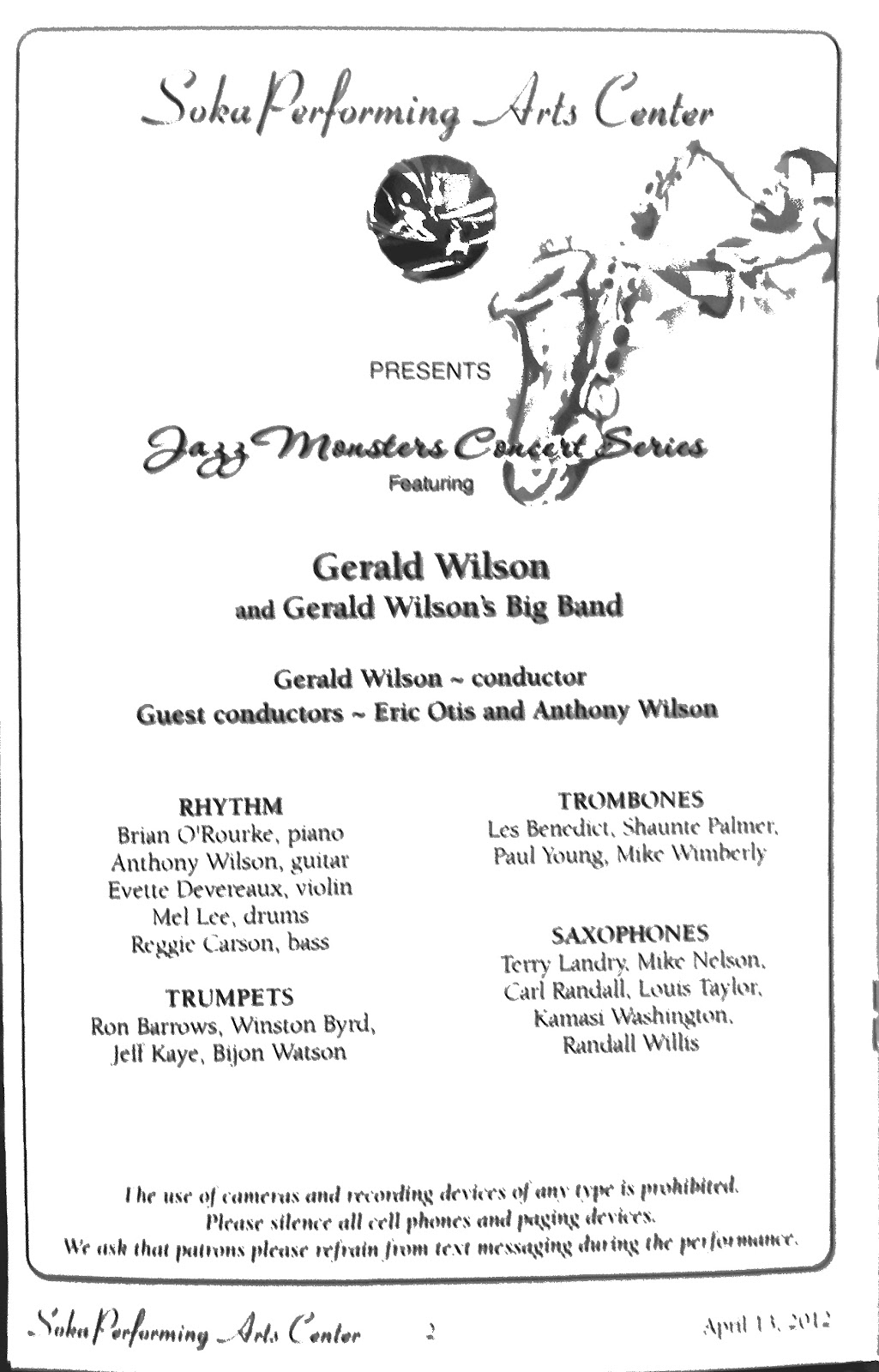
Oh no! Not another "legend!" It seems so easy to drop that handle on someone, some movie star, singer, or whatever. They are legendary, they are great, they are one of a kind, etc. But, this night, I rubbed elbows with a true legend of jazz--again. The legendary, great, one-of-a-kind jazz artist Gerald Wilson rides again. I've played lead trombone with Gerald's big band for sixteen years now, and it's as fresh and exciting as it was the very first time. Gerald was born in 1918 in Shelby, Mississippi, found his way to Detroit, studied music at Cass U., was one of the first black (may I use that term for a "person of color?") men in the U.S. Navy in a non-menial job (he, along with the late trumpet legend--see, there's that word again--Snooky Young, were in the Navy band at Great Lakes Naval Center). He later played with the legendary (oops, it's becoming a habit; but there are legends in jazz, some of whom are not mentioned as frequently as they should) Jimmy Lunceford band, then with Count Basie. He wrote for both bandleaders, and also for the legendary Duke Ellington. He was the first bandleader to record in Capitol Records, on an album accompanying the legendary singer Nancy Wilson in 1963. Gerald started his own big band in Los Angeles in 1947, I believe, and still leads it today at age 93. He is as spry as a youngster when he's in front of the band, and still knows exactly what he wants to hear and how to get it out of the band. I listened to recordings of the band while a college student in the 1960s, and when I was in the Air Force, a hot dog stand behind the PACAF band room at Hickam AFB, Hawaii, had a juke box with Gerald's recordings on it. I would listen and wonder how someone might possibly ever get to play with such a wonderful band. My own career advanced, and I was recruited by the legendary Buddy Collette to perform with his band. In 1996, the Library of Congress brought three West Coast bands from L.A. to Washington, D.C. to perform in the then newly renovated Lincoln Theater. Buddy's band played the first night, Gerald's the second, and the legendary Benny Carter the third night. Gerald attended the performance of Buddy's band, heard me play, and asked his contractor to begin calling me for his own band. In those intervening sixteen years I have missed only one performance with the band, when I was on tour in Japan and couldn't get back to the States for a concert.
 Tonight we performed to a very receptive crowd at SOKA University in Aliso Viejo, California. Gerald was his usual precocious self, keeping the audience laughing at his stories and enthralled at his music. And afterward, Gerald, as always, thanked me for being there and told me what a great musician he thinks I am. I couldn't be more proud. One of my fondest memories as a player is of playing at the Detroit Jazz Festival, where we participated in a Battle of the Bands with the legendary Count Basie Orchestra. After the performance, as I was looking for a safe way off of the high riser the trombone section was perched on, I looked down and saw then 90-year-old Gerald Wilson, extending his arm and saying, "Let me give you a hand, Les; we can't afford to lose you." Of such stuff legends are made.
Subscribe to:
Posts (Atom)