Saturday, July 29, 2023

Trombone Playing Lesson 78


Playing trombone was always easy – until it wasn’t. I started at age 10 in fifth grade, and by sixth grade I got a superior rating at solo/ensemble contest. Onward and upward, until finally bad habits I didn’t know I had caught up with me. I discovered Body Mapping through an accident of fate and good luck.


My journey through learning Body Mapping has been enlightening, to say the least. Learning how to breathe, sit and stand and hold my head correctly has been an adventure. My teacher has been terrific, knowledgeable and patient, and I’ve had additional help along the way. This has led to self-exploration, of course, and the most important discoveries recently have been related to my head and neck. Years of marching bands and military training had taught me to stand/sit “at attention,” head/chin up, shoulders back. Over time, this posture negatively affected my breathing/blowing and tongue movement. This led to the discovery that what I’ve always thought was the center of my aperture wasn’t; through an accidental encounter when I was discussing it with a friend, I found that to get my air to go through the middle – the center of my lips, where they open fully and most naturally when I blow air between them – I have to move my jaw slightly to the right. Then and only then, do I get a perfectly round, efficient aperture. And then things start to work: my sound and accuracy and flexibility improve, and my tonguing frees up (as long as I don’t tilt my head back like I habitually did before). This also sheds light on why the muscles on the right aways seemed weak, leading to an occasional air pocket in my cheek; once I make that adjustment, the right side falls into line and my embouchure is balanced (probably for the first time ever!). It’s an ongoing process, developing new habits to replace the old, but it’s working. Curiously, in brass quintet rehearsal, my trumpeter friend suggested that that setting might be why I have a somewhat extraordinary high range, and he asked me to slur from low to high while he watched. Sure enough, he could see my chin moving to the right as I ascended. So my job now is to train the middle and low registers to be comfortable with this “new” setting.


Source material:

What Every Musician Needs To Know About The Body by Barbara Conable

What Every Trombonist Needs To Know About The Body by David Vining

The Breathing Book (for various instruments) by David Vining


Wednesday, June 12, 2019

Saga of the Gong

I joined the Disneyland Band in 1982, and stuck it out until 1994. The band was legendary in many ways, but internally it was a hotbed for practical jokes. One of our favorite targets was our drummer, Joe, who seemed to take it very well when he was the recipient of such frivolity.

One memorable, long-running gag began when Show Services delivered a new gong for Joe to use when we did a show calling for that sound. But Joe drove everyone crazy, testing out different mallets and sounds within the confines of the band room, which was sacrosanct. Band members used it for reading, study, napping; it was personal time and time for recovery from the rigor of performing. After Joe had been asked numerous to "cool it" with the gong, one of the band members (who shall remain anonymous) took it upon himself to "confiscate" the gong and remove it from the room. He took it upstairs, where wardrobe ladies were happy to be in on the joke and secrete it among the costumes.

When Joe was otherwise occupied (like taking a nap), the gong would magically reappear, the bashing of which would wake him up, but not quickly enough for him to catch the perpetrator. Once, when he was at a convention in Las Vegas, band members called his hotel, had him paged, and gonged him over the phone,

Disneyland hosted the "Circus At Disneyland," featuring acts from Ringling Brothers, including the turn-of-the-century wagon pulled by six magnificent Percheron horses. The band rode in the wagon and played appropriate circus-related music. The highlight, though, after the Human Cannonball, was Ricky Wallenda, tight-wire walking over Main Street. The anonymous gong thief talked Ricky into bashing the gong at the beginning of his show. The band was playing below, and Joe remarked, "Hey, he's got my gong!"

The coup de gras occurred when the band was taking their daily cruise on the Mark Twain on the Rivers of America. The band spent part of their day in "break down groups," splitting up the big band into smaller units. One was called the Frontierland Brass, and the members wore 1800s western garb: cavalry uniforms, sheriff's outfit with badge, etc. -- and one lone Indian. The one who shall remain anonymous hung back as the band assembled to march to the river, and then changed into his Indian outfit. He had access to a car, and drove himself and the gong to Videopolis, which conveniently abutted the Indian village on the river. He situated himself among the animatronic Indians and waited for the riverboat to arrive, with the band sitting on the prow. As the boat passed by, the analog Indian slowly raised his arm, and bashed the gong into the silence, just as the band stopped playing. As the boat disappeared around the bend, so did the Indian, and the gong was never heard again.

Friday, March 25, 2016

Super Nova

What better title to honor an important person in my distant past -- Nova Hudson. Nova was the proprietor of the Midway Restaurant, a favorite hang for music majors of my era at Tennessee Tech, namely the early to mid '60s. I don't know, and never asked, where the restaurant name came from, but it was located adjacent to the Tech campus, behind the women's dorms and a short walk across the street from the music department. Ignoring its rather pedestrian title, we simply referred to it as "Nova's."

What made the Midway unique, at least in the eyes of the musicians from Tech, was that Nova was a music lover, and as such, had jazz recordings on the juke box. Each booth had its own coin-operated controller, so you could sit and pump nickels into the remote box, with its flip-around menus, and pick your favorites. I remember that her offerings included Dave Brubeck; memory doesn't serve up much else, but it was the time when "Take Five" was a big hit, so it included tracks from that album. Nova loved to hang around and talk music with us, unfortunately to the point of boredom sometimes, so rather than be rude, we had a secret weapon. Nova seemed unable to tap her foot to "Blue Rondo Ala Turk," so we would drop in a quarter and opt for five plays of that arrangement in 9/8 meter, each bar repeating 2/8-2/8-2/8-3/8, relentlessly attacking the sensibilities of any decent Tennessean who loved a good two-and-four feel. About halfway through the second playing, Nova would surrender and disappear into the kitchen, presumably to help her husband, Pop.

Nova had the last laugh, even though she was probably more disgusted than anthing else. She approached our table one day and announced a "sad day in music:" Jack Teagarden had passed. We were too naive and unknowledgable to be very impressed, and she just turned around and went into her kitchen refuge. Of course we should have been embarrassed that we either didn't know enough about who Jack Teagarden was, or his stature and importance in the world of jazz history and trombone playing. Now, of course, we do, and that just elevates Nova into superstardom in our memories, that she was even privy to that kind of knowledge in our little world, our mountain town of 3,000 residents and our school of some 2,000 students, and our tiny music department of 23 majors. As it turns out, Nova's brother was Tommy Thomas, drummer on Don McNeill's Breakfast Club out of Chicago, for twenty years. No wonder Nova knew about music and jazz! Tommy taught at Tech for a year or two after his retirement, then moved on to Florida. Much later, he moved back to Cookeville and rode his bicycle around and played drums for other older folks until he was about 100.

Nova and her Midway Restaurant invoke happy memories of my time at Tech, of which there were many.

Capital Pun-ishment

I'm fond of a good joke, but I find a great pun irresistible. One of my favorites concerns Roy Rogers going for a ride on Trigger. Roy had gotten a new wardrobe, and was particularly proud of his spiffy boots. As he was riding through an arroyo, he was leaped upon by a puma that tore his boots to shreds. He escaped and returned home, where he told Dale what happened, grabbed his rifle, and headed out seeking retribution. He found and dispatched the lion and returned home. When Dale saw him ride in with the couger over his saddle, she sang (apologies to Glenn Miller--oh, maybe not), "Pardon me, Roy, is that the cat who chewed your new shoes?"

My nephew Nonda and I have been exchanging stories of this ilk since he was a wee lad, one of the earliest of which dealt with toilet paper and...well, we won't go there. But I fear he has had the last word. His tale:

Ghandi walked all over India, preaching peace and love, and since he was barefoot or wore very thin sandals, the bottoms of his feet became very tough. As he grew older and his health started to fail, he ate lots of curry to try to slow the aging process, which gave him bad breath. So he became a -- wait for it --

-- Super-calloused-fragile-mystic-hexed-by-halitosis. Take that, Mary Poppins!

Thursday, June 5, 2014

Man of Brass


Larry Minick

Arguably one of the greatest brass instrument repairmen of all time, Larry Minick was also an innovative designer and craftsman, who created specialty and unusual instruments. He designed and built a contrabass French horn for Los Angeles Philharmonic tubist, Roger Bobo, and a valve trombone with a gigantic, French-horn-sized bell for the great Bob Brookmeyer. He had a reputation for being a crusty bastard, or a curmudgeon at best, but he had a soft heart and would go out of his way to help players he respected or who were in need. I was in his shop once, watching him do some work for me, when the light from the door went dim. Larry didn't look up to see who it was; he just said, “What the f*ck do you want? The stranger responded, “What the f*ck's it to you? The result? Instant friendship.

Larry's instruments and mouthpieces have achieved cult status since his untimely death, and are widely sought after and copied. My first encounter with Larry was when I was still living in Hawaii. I had traveled to Los Angeles to look for a new trombone, a commercial horn to use in my increasingly commercial career. I called Charlie Loper on a referral from a friend in Hawaii to get a recommendation, and took my old faithful Conn 8H to Larry at a store called Musicians Supply, also on a recommendation, to have it worked on – slide balancing and lightening up the bell and braces. I watched Larry align the slide – he held it up to the light, eyeballed it, and put it across his leg and bent the hell out of it, scaring me crazy. When he finished it, he put it on his marble leveling block and checked it, and it lined up perfectly. (As an aside, while I was there, George Roberts came in and asked Larry if he could put new corks on his mutes!)

After we moved to L.A., I became a regular at Larry's new shop on Sepulveda Boulevard. He started making custom horns, leadpipes and mouthpieces, and his reputation grew as the word spread about his creativity and prowess in instrument repair and design. He was approached by Conn to design a new commercial trombone for them, a specialty .500 bore instrument that came to be called the 100H. It had a distinctive curved hand grip and curved counter weights on the tuning slide. Larry eventually had a falling out with Conn (he told me that he had designed three different but interchangeable lead pipes and sent the prototypes to the factory in Texas. They lost two of them, or messed them up trying to copy them, and asked him to replace them, and he was bugged at their incompetence and refused to do so), and started making his own line of similar instruments, with an improved hand brace and hand-turned and hand-hammered bells.

I was privileged to have had him make two tenor trombones for me, .500 bore horns with 8-inch bells. They were terrific instruments. At one point, though, I decided I wanted a smaller bell for one, to make it more of a jazz horn and visited Larry's shop—by then he had moved to Cambria, California and had set up shop in an industrial complex. When I told him I wanted him to make me a 7 ½-inch bell, he said he thought he might have something similar already made. He climbed a ladder up to an exposed “attic” area and came down with a bell that measured at about 7 ¼ inches. He replaced the 8-inch bell I already had, and let me keep it for a spare.

Larry had a sense of humor which came to light in interesting ways. I was teaching at home, and propped my foot up on my piano bench and put my trombone on my knee. The bench toppled over, my horn went straight down onto the floor slide-first, and my chin hit the mouthpiece. It gave me quite a whiplash, and bent the slide into a rainbow. I took it to Larry in a bag, and when I took it out, he nearly fell off his stool laughing. When he finally was able to catch a breath and speak, he said, “I can fix it.” And he did.

Larry had other interests and skills, like cars. He had some antique cars that he restored (his wife, Doreen, drove a classic T-Bird that he had restored). We went to see him once at his shop in Cambria, and as we were parking, we heard a terrific metallic banging noise coming from inside. Wondering what-on-earth kind of instrument he was building now, we walked in and found that he had a Model A Ford fender in his vise and was banging dents out. He had found a pickup in a haystack near Morro Bay and bought it. He said it was a mess; besides the usual aging issues, rust and so forth, kids had been plinking at it with their .22s. He restored the body and replaced the engine, drive train and suspension and brakes with parts from a 1955 Chevy, and painted it canary yellow. He and Doreen drove it to San Luis Obispo for a car show there, and as they were walking around admiring all the beautiful restorations, amid unending announcements on the P.A. system, Doreen suddenly elbowed him and told him to go pick up his trophy. He asked “for what,” and she said they has just announced he had won best-in-show. He responded, “But I didn't enter.” They had found his truck in the parking lot and given him the top award.

Larry deserved a top award for many of his creations, and for all the good he did for musicians everywhere. He was an innovator, a top craftsman, and a caring, helping person. He unfortunately died at age 55. His legacy is that of exploration and creativity in brass instrument making. He is sadly missed, and now a legend among brass players world-wide.

Here is a link to an article from the Cambrian, quoted on the trombone.org website:

http://trombone.org/articles/library/larryminick.asp


Monday, May 26, 2014

R.I.P. Bronze Buckaroo

The Bronze Buckaroo has passed.

Herb Jeffries has moved on after one hundred years on this plane. Herb made a name for himself by creating and starring in (as The Bronze Buckaroo) a genre of cowboy movies with all-black casts, so that young blacks could have role models like the whites did in Gene Autry, Roy Rogers, and others. He was the first black “singing cowboy,” and as such, attracted the attention of band leader Edward “Duke” Ellington, who asked Herb to sing with his band. According to Dennis McLellan in the Los Angeles Times (Memorial Day, May 26, 2014), “Jeffries, who began singing with what has been described as a luscious tenor, followed the advice of Ellington's composer-arranger Billy Strayhorn and lowered his range to what music critic Jonny Whiteside later called a 'silken, lusty baritone.'”

I worked with Herb on several occasions, and he always proved to be a consummate gentleman. Most recently, I played in the band at Catalina Jazz Club in Hollywood for a celebration of his 95th birthday. He announced he had already booked an appearance in Las Vegas for his 100th birthday. He appeared in a wheelchair, but otherwise seemed to have all his faculties intact. One striking and memorable moment occurred when he recited his favorite poem, a rather lengthy tome, from memory.

Of course, he sang his biggest hit, “Flamingo,” which he recorded in the early 1940s with the Ellington band; it sold in the millions. Which brings me to a recording session I was doing with a Dixieland band: at one point Herb's name came up. The trombonist (I was playing tuba) inexplicably had no idea who Herb Jeffries was. We were puzzled, what with Herb's fame and the trombone player's extensive background in jazz; so we were trying to explain to him who Herb was, when the banjo player chimed in with, “You can count all of his hits on one leg.” (Thanks, Jon, for that memory.)

R.I.P. Herb Jeffries, 1913-2014
www.en.wikipedia.org/wiki/Herb_Jeffries


Monday, May 12, 2014

Look sharp! Feel sharp! B...Natural??

A practical joke is...well, anything but practical, especially to the victim, but the term apparently applies to a gag played on someone that involves something physical, rather than verbal. I've been a victim of a practical joke on occasion, and have been on the sending end as well.

Since my life more or less revolves around the trombone, it seems natural that "the true head of that family of wind instruments" (Berlioz) would be involved somehow in one of my favorites. Somewhere along the line I acquired an antique Conn 5H tenor trombone, a smallish silver-plated instrument with a beautiful sound. I was curious enough to write the C.G. Conn Corporation to inquire about it, and they responded in detail about the horn (this was before they inexplicably destroyed their historical records). It left the factory in 1914 (the exact date escapes me, but I have the letter somewhere, being of the opposite disposition of Conn regarding destroying or getting rid of anything). It was made before "A" was standardized at 440 Hz (or wherever the oboe wants to put itself that day), so it was outfitted with two tuning slides, "high pitch," defined by Conn as A 459, and "low pitch," A 440. The A 459 slide, pushed all the way in, effectively made it "Trombone in B Natural" (in contrast to B Flat, the standard).

There was certainly no practical use for a Trombone in B (it might. of itself, be considered a joke), but it occurred to me that it might be put to use in a practical joke. And lo and behold, an ideal situation presented itself. I was playing in my college marching band, a requirement for instrumental music education majors, and the band director approached me to say he wanted to feature the jazz band on a number in the upcoming half-time performance at Saturday's football game. This was before battery amps made electric basses possible on the field, and he wanted me to play the bass lines on Sousaphone for that one number.

We worked it out with one of the Sousy players who also played trombone, so that as we passed each other on the way to the formation featuring the jazz band, we would swap instruments; he played trombone on the one "big band" number, and I played the bass lines on Sousaphone. We then swapped back on the way to the next formation.

You can guess what happened next: we rehearsed all week and got the instrument swap really down, then on game day I took the Trombone in B on the field and transposed all my parts (I have a pretty good ear for that stuff). After handing off the trombone and taking the Sousaphone, I could hardly keep from cracking up, listening to my friend try to figure out what I had done to him, or probably more to the point, what was wrong with the horn. We subsequently switched back, and I continued to transpose so that my parts sounded normal. I never let on what I had done to him.

The trombone has been the butt of many a musical joke (What do you call ten trombones on the bottom of the ocean? A good start...), but I bet it hasn't been used that much on the other end of a joke. Trombone naysayers beware...

Monday, April 7, 2014

Chameleon

The Chameleon...

I started on piano as a kid, but for some reason it never held the allure for me that it did for others. Evidently my parents had made my sister practice piano (and she became quite an accomplished pianist and teacher), so maybe that's why they didn't have the patience or wherewithal to force me to spend hours of servitude.

But when the trombone came along, the magic hit. I started playing in fifth grade, and by sixth grade had gotten a superior rating at Solo and Ensemble competition. And the game was on. I don't recall being much interested in anything else but music, at least for very long, but I played, and sang in church, glee club, barbershop chorus, and even started my own barbershop quartet. When I asked my high school band director about starting a dance band, because nearby Harriman High School had one, he said he wasn't interested but pointed me toward a file cabinet in his office that had dance band music in it, and said I could start one myself. So I did.

I recruited three trumpeters and another bone player, three saxes and a rhythm section (Alvin Grisham on piano and Doug Henry on drums--there was no bass, and no one to play it if there had been one). The school had no dance-type drum kit, so Doug jury rigged one from what was available in the band room. We rehearsed, and before long had some gigs.

But I digress. My coat started adding many colors when I decided to play clarinet in summer band. I don't remember how that went, but the following summer I played sousaphone (the school had no upright or concert tubas). Then I started at Tennessee Tech as a music education/ trombone major, and somehow one of the other trombone players, Charlie Kirkpatrick, found out I played tuba and asked if I would play in the Dixieland band he was forming. And I was off and running, listening to Dukes Of Dixieland recordings and learning tunes and how to play bass lines. And that first year we won first place in the spring talent show!

Dr. W. J. Julian, the very popular band director at Tech, had left for greener pastures at the University of Tennessee, and most of the upperclassmen followed him. So we 23 music majors endured a disjunct department with an interim Chairperson whom we adored, but who had a commitment for the following year and couldn't stay on. My sophomore year saw the arrival of Dr. James Albert Wattenbarger, a Tech alumnus and graduate of Northwestern University. He had the unenviable task of rebuilding the broken department, and set about doing so by emphasizing performance. He began hiring accomplished players for the vacant faculty positions, including Patrick McGuffey on trumpet. Pat had been in the Army Band and Louisville Symphony and brought a high level of expertise to the department.

Shortly after the beginning of the school year, Mr. McGuffey approached me by my locker and said, and I quote (even after all these many years), "I hear you're the trombone player." And he proceeded to ask me if I was interested in playing trombone in the "faculty" brass quintet he was forming (there were only two brass players on the faculty at the time, Pat and the horn instructor). He planned to augment the group with student instrumentalists. Of course I quickly agreed. Then he asked whom I would recommend for the tuba chair, and after I quickly ran down the list of available players in my mind, I responded, "Well, me," honestly believing I would be the best choice. He said, well then who would you recommend for trombone? I suggested my pal and classmate, Horton Monroe. Kelly Bussell was the best "legit" student trumpeter, and we had our quintet.

The school owned a few tubas, old King recording tubas with front-facing bells, not exactly top pro quality, but miraculously a Mirafone CC and a DuPrins/Walter Sear CC appeared, and they were mine for the duration! Four years of playing with a premier group, rehearsing three days a week and playing for MENC conventions and more, and even a TV series for the Nashville PBS affiliate on the history of brass instruments. When I was ready to graduate, I was prepared to take a local junior high band director job and keep playing with the quintet, but instead I got drafted, joined the USAF band program and went back to being primarily a trombone player. Dr. Wattenbarger hired Winston Morris for tuba faculty, and he has proceeded to create a tuba dynasty at a Tech, with his tuba ensemble having seven Carnegie Hall performances under their belts!

But back to diversity: besides tuba in the quintet, I played tuba or principal trombone in the symphony, depending on which was needed; first trombone in the concert band and jazz "Troubadours;" euphonium in the symphonic wind ensemble, and even drums with a "pop" vocal group.

I have, along the way, delved into strange arenas: E flat cornet, E flat alto flugelhorn, E flat helicon bass, marching trombone and G contrabass bugle with Clare Fischer. E flat valve trombone with the California Gold Rush Band. E flat Alto horn on the soundtrack to the movie Glory. Marching baritone with the Disneyland Band. Alto trombone on the Mozart Requiem. And even trumpet once on a Power Rangers cartoon episode (along with tenor & bass trombone & tuba).

With my partner, Steve, and two friends,
alto valve trombone
Opening Day at Dodger Stadium,
with my E flat helicon


I continue, some fifty-odd years after my little experiments began, to wear many hats. This year alone (2014) I've played first trombone with the Glendale Pops Orchestra, 2nd with the San Fernando Valley Symphony, bass trombone with the New Valley Symphony, and tuba with the Thousand Oaks Philharmonic. I've recorded Dixieland trombone for the Disney Company, played euphonium with the Royal Hawaiian Band (America's only full-time municipal band), and I regularly play bass trombone or tuba (or tenor trombone) with the orchestra or brass ensemble at Grace Community Church. I played polka band tuba for a convention in Las Vegas, several Dixie gigs on helicon tuba with the Angel City Dixieland Band, trombone with the Smithsonian Masterworks Jazz Orchestra and a high school production of Cabaret, and bass trombone on American Idol backing Harry Connick, Jr. I've played lead trombone with the Gerald Wilson Orchestra for 19 years, and at age 95, he's still going. Amid all that chaos, I found time to play with various big bands and small groups, and try to keep up with the few "rehearsal" ensembles I play in, and find time to practice in between. And in the interest of further diversity, I've applied for instructor certification training in Body Mapping, a system for musicians based on the Alexander Technique. I'll travel to Flagstaff, Arizona later this month for training.

Besides nurturing my sanity, all this diversity has kept me working, in a time when many musicians are complaining about business being very slow. I guess I always wanted to do it all, rather than stick with one instrument and wish I could have some of the fun I saw others having. I’m not setting the world on fire, but those seeds I planted so long ago have definitely born fruit, of many varieties and colors. And it's still fun and challenging. Winnie the Pooh asked Piglet, "What day is it?" "It's today," squeaked Piglet. "My favorite day," said Pooh.

Monday, March 31, 2014

What It's All About

"You put your right foot in, you put your right foot out...


Not exactly what I'm thinking all about. I'm thinking about my attention, and where I should direct it, namely to alleviate stress. St. Paul, in 1st Corinthians 3:16, said (variously translated, but the meaning isn't lost) Know you not that you are the temple of God, and that the Spirit of God dwells in you? To me, I see this as meaning to look inward or inside myself, for God, whatever God is. God, most likely, if there is one, is so far beyond our ability to understand or comprehend that we might as well not look, at least "out there somewhere." Science keeps looking more and more inward, at smaller and smaller things, for "the meaning of life," leading to the discovery of atoms and their components, then  quantum mechanics, quarks, Higgs boson, and wherever all this takes us. But it seems to be taking us to smaller and smaller places, more and more "inward."

Where it takes me is back to my discovery, in a time of need, of Transcendental Meditation. I was feeling very stressed, and finding no solution in exercise, yoga, nature, or other places I looked. I was working in Hilo, Hawaii, and wandered into a bookstore and discovered a small book on TM. I purchased and read it, and decided it was exactly what I needed. So as soon as I got back home to Honolulu, I sought and found the local TM center and signed up. It involved classes so that I would know exactly what I was  getting into and what to expect. Then I was assigned a teacher who sat with me and taught me the actual technique. And I was hooked. Maharishi Mahesh Yogi spoke of a "field of all possibilities," a place where there was at once nothing and the potential for everything, all at the same time. And I went there, an absolutely indescribable place of not quite nothingness, but of infinite peace. It was as if I was all alone in the entire universe. And that is what is hoped for all who learn it, although I found later that not everyone achieves that. But my teacher(s) said that is the magnet for continuing the practice, to keep trying to get back to that place.

Let me regress: I had a lateral lisp for most of my life. All my "S" sounds came out of my side teeth, not my front ones. I had speech therapy as a child, and continued to try to figure out how to get rid of it into adulthood, even going to the U. H. speech therapy center when I was in graduate school at the University of Hawaii. And nothing worked, until about a week after learning TM, I noticed (without thinking about it or trying to do anything about it) that it was GONE. I was speaking normally for the first time, then and forevermore. The only thing that had changed was that I was looking inward twice a day for twenty minutes.

Coincidentally, I once worked with a show conductor who had a similar experience: he stuttered, and his stutter disappeared when he learned TM. When he stopped practicing for a while, it came back, but disappeared again when he returned to meditating. Stress therapy? Looking for God? Shutting out the outside world? Just relaxing by closing one's eyes? Who knows? There is lots of information about research that has been done on the benefits of practicing TM, but I have my own story, and it's a good one. You put your right brain in, and your left brain, and your whole consciousness, and look what happens. And that's what it's all about...

Friday, March 28, 2014

Imposters...

...are rampant. At least, that appears to be the case, in the music world, if not permeating our entire world. Many musicians, for example (and where I'm headed with this observation), are universally praised, frequently when they are nowhere near the elite status they are generally afforded. The question arises whether they are really thought of as being that good, or if their public (frequently other musicians) is simply being polite, or (ahem!) if the listeners really don't know, or are being fooled, or hoodwinked, or are fooling themselves, or are just going along with the crowd. In my experience, many musicians who are lauded in public and private do not deserve to be included in that elite top-tier of the truly great. That leads me to think that the majority of listeners are not sophisticated enough or knowledgeable enough to really know the difference between technical prowess and true artistry.

The creation of music involves many facets, but foremost of these is the ability to communicate with the listener. Some have been well educated, have spent countless hours in the practice room developing and honing their craft, many more hours listening and learning from the ones who came before, and so forth and so on. But sometimes (and perhaps frequently) someone comes along who is lacking in one or more of the elements we think of as being a requirement, such as having a pleasant voice (or sound on an instrument), or a knowledge of theory, or other things, but they have a gift for communicating with an audience, of "clicking" within a certain genre, and they become stars. So all of those elements taken together are not necessarily the answer. Indeed, sometimes the elements have been studied, practiced to perfection, but that one special talent, the ability to communicate, is missing. But too often, to my way of thinking, the listener is not sophisticated or learned enough to know the difference. A friend of mine long ago had business cards made up that read, "If you can't dazzle 'em with brilliance, baffle 'em with bullshit." So many listeners (and critics) seem to be baffled, or at least fooled. Maybe they are just trying to be, or seem, sophisticated or knowledgeable. Maybe it's a matter of intelligence; after all, half of us are at or below average intelligence. Maybe IQ has something to do with it; I don't know. I do know that I am sometimes impressed with the technical prowess of someone I hear, but hearing them once is enough. I don't seek out further opportunities to listen to them, live or on recordings. They don't move me. But then someone will come along who says things in the simplest way, but it strikes at my heartstrings, and a bond is formed.

There is an emotional element in true communication between artist and observer, in music and art, in poetry and prose. Of course we all have our own interests, and we tend to pursue the genres that do interest us, but sometimes something from outside our experience will intrude on our consciousness and pique our interest, and we experience, well, expansion. Our world has just gotten larger.

Monday, April 8, 2013

"What color is he, anyway?"

That was reportedly the response George Shearing gave an interviewer who asked Shearing, "How come you're using a colored drummer?" "I never really thought about it. What color is he, anyway?" Shearing, you see, was legally blind, so "what color is he" might have been an appropriate response, if he didn't have any other of his six senses. I suspect that Shearing's tongue was planted firmly in his cheek, and that was his way of not responding in the nasty way he might have been entitled to. He was also British, where black and white seem to be colors more than separatist races.

The color of one's skin has long been an issue in the music world (and elsewhere, obviously), and this opining and sometimes outright discrimination on both sides deserves some pondering. Jazz bands were segregated for many years, but in the '30s some white bandleaders, notably Benny Goodman, realized what they were missing by not simply hiring the best players available, regardless of color, and began hiring black artists. Tommy Dorsey, wanting to expand the musical scope of his very popular orchestra, famously hired the great arranger Sy Oliver away from the also popular Jimmy Lunceford (black) band. Producer Norman Granz (Jazz At The Philharmonic) was a noted anti-racist and hired whites and blacks and treated them equally.

But from my experience in the jazz world in Los Angeles, there seems to be an undercurrent of separatism that I've been at a loss to understand. White bandleaders seem, almost without exception, to put together all-white bands. But the "why" is what I don't get; I played in a band led by a white drummer who had put together an all-white band that was working clubs around L.A. He once called me and said he was desperate to get a tenor sax sub for the following day's rehearsal. I suggested he call a black player who happened to be my friend and co-worker in another band (led by a black), and he replied, after a small hesitation, "Do you think he'd want to do it?" Meaning, I think, that he had a  great deal of respect for my friend, but he might have thought there was a racial divide that doesn't really exist. He did call Carl, who not only agreed to rehearse that day, but became an important, no, an integral, part of the band. (Carl has passed away since I started writing this, and some measure of respect and the high regard in which he was held could be seen in the attendance and participation in a fund-raiser that was held to help with his funeral and related expenses. It was attended by people of all races, who gladly performed to help his family in their time of need.)

I more recently played a rehearsal with a "white" band, and another black saxophonist friend was subbing that day. I welcomed him to the band, and he said he'd been trying to get into that band for years. I know that some, maybe many, maybe all, of the white band leaders work with black musicians in other venues, and have friends who are black, and respect them on both counts, so I don't get what's going on. It certainly and obviously has nothing to do neither with musicianship nor racism, as far as I can tell.

On the other hand, the black bandleaders seem to always have a healthy mix of players. I played and recorded with Buddy Collette at the Lincoln Theater in Washington, D.C. for the Library of Congress, and Buddy's band had blacks, whites, hispanics and even women. Buddy was definitely an equal opportunity employer, and hired on basis of musical ability and personality. Color never entered into it. I've played with the Gerald Wilson Orchestra for some seventeen years, and he has the same mix in his band. John Stephens does the same. There seems to be something like reverse non-discrimination here somewhere. Other players I've talked to have observed the same thing but don't seem to have an answer. Perhaps it's simply tradition, status quo, or not thinking about it.

Perhaps I'm seeing a problem where none exists; I do see and perform with blacks in other venues. I have black friends that I'm as close to as my white friends (and hispanic, and women, and even redheads -- take that, Conan Doyle!). I've spent a lot of time writing this in a way that makes sense to me, and have hesitated posting it out of concern for offending someone, so maybe it speaks more of me than the situation I've put forth. I was, after all, raised in a segregated community in the south, and only went to school with (a few) blacks late in my college career. My parents taught me to not be prejudiced, and when I enlisted in the U.S.Air Force, I worked with blacks on a daily basis and had the greatest respect for them and their wonderful musicianship (as well as for my white co-workers). But I still saw racism on some level, even there.

So what was the question?? More important, what is the answer??


Sunday, April 7, 2013

Who's The Leader Of The Band?

Not THAT band. We all (of my generation) know that that would be Mickey. I had that revelation reinforced during my eleven+ years working/playing with the Disneyland Band, with Mickey frequently leading us down Main Street, USA.

No, the band I'm referring to -- well, let me backtrack a little. When we first moved to Los Angeles, I found I had dived headfirst into a huge melange of music. There were numerous big bands, small bands of every ilk, brass and woodwind groups, orchestras seemingly in every community large and small, and on and on. One of the first bands I hooked up with, for a week of work, was led by the inimitable Bill Berry, the cornetist who played with the great Duke Ellington from 1961-1964, a rare example of a white player in a black band. Bill later led his own band, and I was called to join the group for this outing.

We played three or four nights at a theater in Oxnard, California, northwest of L.A. Then we did a couple of nights at what was then the jazz mecca of Los Angeles, Carmelo's Jazz Club in Sherman Oaks (Bob Florence famously dedicated a song to it, the title a nice play on the famous "Carmel By The Sea" -- Carmelo's By The Freeway). The amazing trumpeter, Cat Anderson, sat behind me, and played with such intensity that I wondered if I would ever hear again. There were other luminaries in the band as well, such as lead alto saxophonist Med Flory, the founder and leader of the amazing group, Supersax.


Which brings me to the title of this tome: Who's The Leader Of The Band? After our nights in Oxnard, we went into Carmelo's. Med Flory was replaced by the great Marshall Royal, who had just left relative stardom with the Count Basie Orchestra. And things changed. Marshall was such a domineering (and I mean that in a good way) player, such a natural, strong leader, that the entire feel of the band hand changed. It amazed me that one player, who was not the lead trumpeter or the drummer, could effect such a change (and for the better, I thought). It just somehow added something to the cohesiveness of the band. Med is a great player, and I certainly don't mean to disparage him or his musicality, but it was just...different. It was quite a music lesson for me.

I had the distinct pleasure of working and hanging out with Marshall many times, as he became the lead alto saxophonist with the Ray Anthony band, with which I played for ten years.

********

While I'm on the subject of leading, I am reminded of when I played lead trombone with the Toshiko Akioshi/Lew Tabackin Band for a while in the early 1980s. My first gig was three nights at the Chicago Jazz Showcase, followed by a concert at the Boston Globe Jazz Festival, held at the Berklee School of Music. The first night, I thought I should kind of lay low and see how the bone section did things. And it was a relative disaster! Starting the second night, I just played lead the way I know how, and everything was fine from then on. I coincidentally learned about dedication: when we hit the hotel in Boston, I think I hadn't even opened my suitcase when I heard Lew practicing down the hall. Lesson noted.


Saturday, February 23, 2013

Elementary, ...

...My Dear Watson. Love that show about a latter-day Sherlock Holmes (Jonny Lee Miller) and his Wonder Dog, mighty Watson (Lucy Liu). Holmes is, of course, as was Doyle's character, an addict, and Watson is his "Sober Companion" who watches over him to keep him sober, accompanies him to AA meetings, etc.

All this is to preface my experience with a "real" Sherlock. Bethel Carrington was a Campus Cop. I met him during my first week on the campus of Tennessee Tech my freshman year. My dad had told me to look him up; he was there when Dad went to school there thirty years earlier. Of course no one used his given name. He was simply (and affectionately) known as Sherlock. He was perhaps the most beloved figure in the history of the school. And he was second generation--his father had been Sherlock before him.

I searched him out soon after I arrived at Tech. I was wandering around the campus (probably scouting out the women's dorms) when I bumped into a uniformed gent locking up the buildings for the night. I asked him if he was Sherlock -- "No," he said; he was Mr. Allen -- "but I'll take you to him."

Sherlock could have hung the moon, as far as the students were concerned. He was involved in all manner of student activities, including blazing the path for a hay ride. I drove the tractor for that one, and had to back the wagon several hundred feet when Sherlock inadvertently led us down a dead end dirt road. (There was also a hay-loaded 10-ton Coke truck, which I drove back 30 miles to Livingston at the end of the night.)

The Civil Rights activist group, Freedom Riders, arrived at Tech, and were promptly pursued and run off campus by a large contingent of students, where they holed up in a local Baptist church. The situation looked dire, until old Sherlock climbed up the steps of the church and raised his hand. When the crowd quieted down, Sherlock said, "Now, kids, y'all go on home." And they did. That's all it took with Sherlock.

The measure of esteem with which he was regarded in the eyes of the students was perhaps epitomized when the university held a contest to name the newly constructed married students housing (which replaced the rat-infested World War II "temp" buildings). The overwhelming winner? "Sherlock Homes," of course!*

*The University powers-that-be reneged and chose the mundane title of "Tech Village," cowards that they were. No respect...

Thursday, February 21, 2013

Elvis lives!

I just saw him at the corner 7-11 buying a bag of chips and a Slurpee. I guess he's everywhere, judging from the number of impersonators I see advertised. There's a big celebration taking place in Hawaii this week, commemorating the 40th anniversary of the world's first satellite-live television broadcast, Aloha From Hawaii. It's claimed that it's the most watched television show ever. It was also a quintuple-platinum album on RCA label. It's been released on video tape, CD, DVD, and even had a chocolate version (non-playing, of course) released. In 1988 RCA released The Alternate Aloha, a CD of the dress rehearsal.

Elvis Aron Presley died in 1977, four years after the huge extravaganza in Honolulu. Reportedly his estate makes more money today than he made while he was living. The imitators wasted no  time in jumping on the bandwagon. I had just moved to Nashville when he passed, and got called to do a recording session featuring a singer named Elvis Wade, singing his composition, The King Is Gone. He wrote it in a day, and it roared to number three on the charts being replaced by another singer's recording, Memories of the King. It seems a lot of entertainers are making a living by giving fans their Elvis fix.

All this leads to why I brought all this up: I had the pleasure of playing on that performance/broadcast. It was a huge deal, hours of rehearsal crammed into a very short time, late nights (I copied the orchestra parts for one number he wanted to add at the last minute, pulling a near one-nighter then having to work the show the next day). The staging was spectacular, and Elvis was really on, performing at his best. An announcement was made in the press that both versions of the concert, Aloha From Hawaii and The Alternate Aloha are to be released this spring as a remastered double CD set. Mmm... Royalties!

My brother Dan researched and listed all the musicians who played in the orchestra in the Wikipedia article about the concert . Thanks, Dan!

Wednesday, April 18, 2012

Bill Cosby...

...is an American icon. Most, if not all, of us have followed his career with interest. Going way back, my Hawaiian jazz singer friend Jimmy Borges told me once about being the resident host and singer at a club in San Francisco called the Hungry I (http://en.wikipedia.org/wiki/Hungry_i), which was the jumping-off place for the careers of many entertainment luminaries, including Cosby. But my story picks up a little further along:

In the early 1970s, I played trombone in the orchestra of Don Ho, the famous Hawaiian entertainer. Don was always on the lookout for celebrities in the audience whom he could ask to join him (or goad into joining) onstage and wow the audience. Cosby was in one night, and Don invited him up. Cos came onstage and looked for a place he could comfortably stand and deliver his routine du jour. The stage was crowded with musicians, as Don had added a string section, and Cos looked around, then down at me (I was seated in the front of the orchestra), grinned, and settled his rather large foot right on top of mine. And proceeded to do fifteen minutes, while standing on my foot.

Cosby went on to become a superstar in the true sense of the word, but he is a jazz lover at heart, and one of his regular "gigs" has been hosting the Playboy Jazz Festival at the Hollywood Bowl. On one occasion when I was performing there with the Gerald Wilson Orchestra, Cos introduced the band, and as the turnstile cranked us around to face the audience, I jumped up, ran over to him, and said something like, "Hey, Man, I'm the dude whose foot you stood on at the Don Ho show thirty-five years ago." He responded, "Was that You??" and gave me a big bear hug.

Therein lies the tale of my close encounter(s) with one of my favorites: I Spy, Fat Albert, The Cosby Show, etc. Perhaps there'll be another meeting down the road. Fond memories...

Saturday, April 14, 2012

Night With A Legend

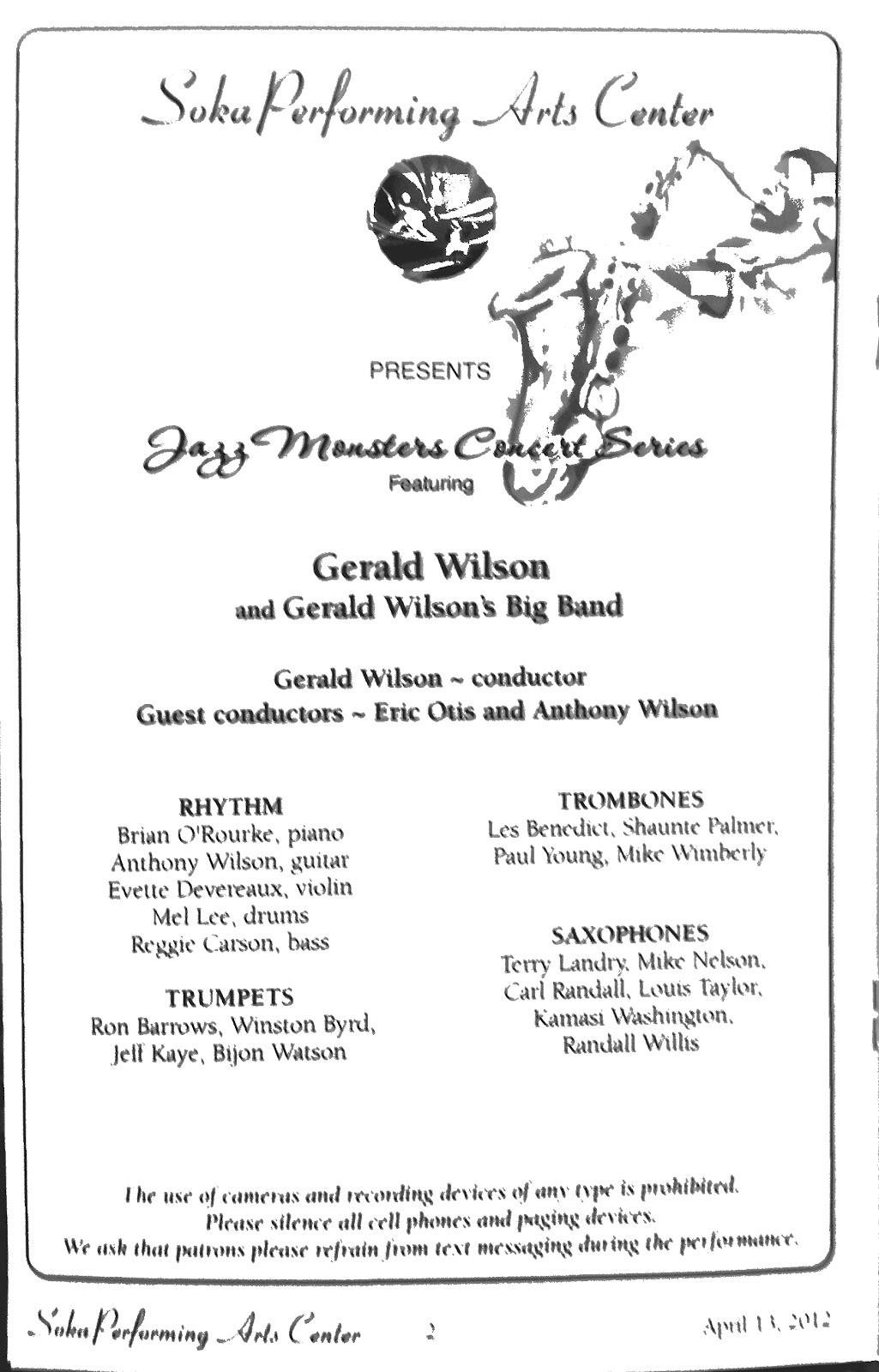
Oh no! Not another "legend!" It seems so easy to drop that handle on someone, some movie star, singer, or whatever. They are legendary, they are great, they are one of a kind, etc. But, this night, I rubbed elbows with a true legend of jazz--again. The legendary, great, one-of-a-kind jazz artist Gerald Wilson rides again. I've played lead trombone with Gerald's big band for sixteen years now, and it's as fresh and exciting as it was the very first time. Gerald was born in 1918 in Shelby, Mississippi, found his way to Detroit, studied music at Cass U., was one of the first black (may I use that term for a "person of color?") men in the U.S. Navy in a non-menial job (he, along with the late trumpet legend--see, there's that word again--Snooky Young, were in the Navy band at Great Lakes Naval Center). He later played with the legendary (oops, it's becoming a habit; but there are legends in jazz, some of whom are not mentioned as frequently as they should) Jimmy Lunceford band, then with Count Basie. He wrote for both bandleaders, and also for the legendary Duke Ellington. He was the first bandleader to record in Capitol Records, on an album accompanying the legendary singer Nancy Wilson in 1963. Gerald started his own big band in Los Angeles in 1947, I believe, and still leads it today at age 93. He is as spry as a youngster when he's in front of the band, and still knows exactly what he wants to hear and how to get it out of the band. I listened to recordings of the band while a college student in the 1960s, and when I was in the Air Force, a hot dog stand behind the PACAF band room at Hickam AFB, Hawaii, had a juke box with Gerald's recordings on it. I would listen and wonder how someone might possibly ever get to play with such a wonderful band. My own career advanced, and I was recruited by the legendary Buddy Collette to perform with his band. In 1996, the Library of Congress brought three West Coast bands from L.A. to Washington, D.C. to perform in the then newly renovated Lincoln Theater. Buddy's band played the first night, Gerald's the second, and the legendary Benny Carter the third night. Gerald attended the performance of Buddy's band, heard me play, and asked his contractor to begin calling me for his own band. In those intervening sixteen years I have missed only one performance with the band, when I was on tour in Japan and couldn't get back to the States for a concert.

Tonight we performed to a very receptive crowd at SOKA University in Aliso Viejo, California. Gerald was his usual precocious self, keeping the audience laughing at his stories and enthralled at his music. And afterward, Gerald, as always, thanked me for being there and told me what a great musician he thinks I am. I couldn't be more proud. One of my fondest memories as a player is of playing at the Detroit Jazz Festival, where we participated in a Battle of the Bands with the legendary Count Basie Orchestra. After the performance, as I was looking for a safe way off of the high riser the trombone section was perched on, I looked down and saw then 90-year-old Gerald Wilson, extending his arm and saying, "Let me give you a hand, Les; we can't afford to lose you." Of such stuff legends are made.

Wednesday, March 28, 2012

What's In A Nickname?

Names are fun to research, sometimes, to find the derivations or hidden meanings. But what about nicknames? Many are obvious. In my own past I have known a "Fats" (obvious origin), "Chubby" (the same), "Red" (hair color), "LeanJean" (the opposite), and many more. One in particular stands out in my memory, because of the circumstances that led to it.

One of my dear friends in college, a fellow trombonist who played in the faculty brass quintet as a student (I played tuba), was Horton Monroe. Horton hailed from Old Hickory, Tennessee, home of President Andrew Jackson and named for Jackson's nickname, interestingly enough. Horton had blazing red hair, but somehow that monicker never seemed to stick to him. But read on...

There was an area of Cookeville, Tennessee, our college town, known as the Triangle (gee, another nickname--who'da thought?), where three streets met to join that shape. It was home to several establishments where students liked to hang out (for food, of course). One such place featured "fast food," but also had a patio area with a juke box and several coin-operated critter-based rides for the kids. One of the rides was a red pig, and of course one night we dared red-headed Horton to ride the pig. He climbed on, and the poorest one among us, Steve McBride (another trombonist), who never had enough money to even eat regular meals (he was paying his own way through school, as his farmer parents wouldn't support his desire to become a music teacher), whipped out a dime (big bucks in those days) and stuck it in the slot. Horton rode the entire dime's worth, uttering an occasional "Heeyah, Pig."

Apparently the word got out quickly about Horton riding the pig. The Belle of the Music Department, Patty Raines (later Ferrell), walked into the student lounge the next day, and seeing Horton sitting there, quietly intoned, "Pig-gy." And Horton was "Piggy" from that moment forward. He hated it, but he had no say in the matter. Patty had spoken.

Now that we've reached our Golden Years, everyone seems to have finally relented, and Piggy has become Horton once again. But the memory of "ride-em piggy" will never fade. Long live Piggy (er, Horton).

Saturday, February 18, 2012

Can you say "simpatico?"

I'm not certain that I can, after attempting to decipher the pronunciation marks in Dictionary.com  (sɪmˈpɑːtɪˌkəʊ, -ˈpæt-). But I'm sure that I experienced it today, while participating in adjudicating a high school jazz festival and conducting a master class, with the day culminating with a combination jazz clinic and concert with all the clinicians participating. It was a sterling example of interaction among all of us, both musically and educationally. Each one had something to contribute as we explained what happens within a group improvising jazz, how we listen to and play off each other, and how each wind instrumentalist and rhythm section player complements the soloists and the group effort.

The guilty parties were: John Proulx (Grammy winner) on piano and vocals; Larry Holloway (Red Mitchell Scholarship Award winner) on bass; Dave Tull (Chuck Mangione band), drums; Jay Mason (Gordon Goodwin's Big Phat Band), alto sax, Frank Potenza (University of Southern California faculty), guitar; and Jeff Jarvis (Chair of Long Beach State jazz department), trumpet. I played trombone, but I did have one tuba player in my clinic. Four bands participated (a fifth was a no-show, but that gave us more time with the one that did make it). We all adjudicated each band's performance, then we took turns, three at a time, pointing out to the students what we thought they could do to improve. The kids were all very receptive and respectful, which made our job easier and more worthwhile. The band directors all seem very dedicated, and were grateful for the help we gave their students, which makes their job easier too, I'm sure. All in all, it was a very good day.

Saturday, February 4, 2012

Yet Another Mouthpiece Story

I know, one tale is probably enough when one is writing about mouthpieces, contrary to the subject of my previous blog, but since it's such a serious subject with brass players, I thought another might not be too over the top.

I was playing with the Bill Watrous Big Band in a performance for the International Association for Jazz Education (IAJE) Convention at the Long Beach Convention Center. My daughter, Mikie, was visiting and went with me, and we got there early, way before the other band members. Bill was the only one there, setting up the band, so I was getting my trombone out and checking out the music, when the door of the large room we were in opened and a lone gentleman walked in. He shuffled slowly down the aisle toward the bandstand as if he had some trouble walking. As I watched him approaching, I realized I recognized him from having seen him on TV: it was Al Grey, the legendary trombonist who played with the great Count Basie for many years. I asked Bill if it was really him, and Bill said, "Yes, go and introduce yourself." (The walking problem was because of surgery he had had on his feet, the result of his diabetes.)

Mikie and I did just that, and we talked with him for some twenty minutes or more. One of the things he told us was about his mouthpiece; hence this tale presents itself. One of my trombone heroes was Trummy Young, whom I had known when I lived in Hawaii (I actually played on his very first album as a leader, and my brother, Dan, who was visiting at the time, took photos of the four trombonists during the recording session, one of which was used on the back of the album). James (Trummy) Young was famous from his years of playing with Louis Armstrong, and his appearances in movies with Satchmo's band. But his path began years before, when he played with the popular and highly regarded Jimmy Lunceford Orchestra in the 1930s, along with such future luminaries as Gerald Wilson and Snooky Young. When Trummy left the Lunceford band, Al Grey took his place. In those days, bandleaders knew their audiences expected to hear songs as they were played on their recordings, so soloists were required to play the same solos they did on the records, note-for-note. When a new player joined the band, he had to memorize the recorded solos of the previous player.

Thus Al had to memorize Trummy's solos. And he said he could play them all, including the challenging "Annie Laurie," but Trummy's solo on "Margie" presented a dilemma for him: at the very end, Trummy played a low D (in the staff) and "glissed" or "ripped" up nearly 2 1/2 octaves to high F sharp. Al said he had no problem with the F sharp, but the tessitura of the entire solo was so high, he coudn't play the low D: his embouchure was locked into playing in the high register. When he bumped into Trummy a few months later, he related the problem, and Trummy reached into his pocket and handed Al a mouthpiece and told him, "Here. Try this."

And try it he did. For some fifty years. He called it "the magic mouthpiece." He said he could play anything and everything on it. Then tragedy struck. He had just done a Master Class at N.Y. University, and the music teacher invited him for coffee afterward. While they were having coffee, someone broke into Al's van and stole his horns -- and the magic mouthpiece! Al was, of course, devastated. He tried many replacements, including some fifty mouthpieces that people sent him from all over the world. And none worked. They were the wrong size, the wrong shape, didn't feel right, struck his dentures in the wrong place, or something.

Some time later, I remembered a mouthpiece that Trummy had given me years before in Hawaii, when his wife was making him get rid of extra stuff he didn't use. I located it and started thinking about a way to get it to Al for him to try out. Meantime, another celebrated trombonist passed away. Melba Liston was one of the few women to make a name for herself in jazz, both as a trombonist and as an arranger. I attended a service for her in Los Angeles at O.C. Smith's church, and performed with saxophonist Ann Patterson's band. After we played, I sat in a pew to hear the speakers and the other performers, when who should walk in and sit right in front of me, but Al Grey. I leaned forward and whispered a reminder of who I was and told him I had a mouthpiece for him to try. He was concerned because he had a high profile recording session with Tony Bennett coming up in a few days, and was worried about how well he would be able to play. We arranged to meet at his hotel the next morning.

When I showed up at his room at 9 AM, he had his horn out and was practicing. I handed him Trummy's mouthpiece, a plain one with no maker's name on  it; it simply was stamped with the initials "TY." Al stuck it in his horn and played a few notes, and his face lit up with an angelic smile. He said, "Now Les, you be thinking about how much you want for that mouthpiece. I replied that I couldn't charge him for it; I was merely the messenger. Trummy had come through for him again.

I phoned Al in New York the following Tuesday to ask how the previous day's session had gone with Tony, and he said it went great. Al played that mouthpiece the last year of his life, and after his death, his wife donated it to a museum, along with other memorabilia. I was unable to attend his memorial service in New York, but I wrote the story of the mouthpiece and his wife had it read it at the funeral.

The TY mouthpiece may have been a true match for the "magic mouthpiece," or it may have simply been psychological on Al's part. But it worked for him, and I'm happy to have been a catalyst to his happiness in his last days of the great player he was.

Wednesday, February 1, 2012

If One Is Good...

...two are better. Right? Depends, but in this case, better for musicians.

The UCLA Medical School graduation ceremony for years has utilized brass music. It's perfect for outdoors, where the rites are held, and can be stylistically diverse, upping the entertainment value. At first they hired one quintet, but the promoter complained about the time between numbers, and the players' "phbllllth" sound, buzzing and flapping their lips to try to get some blood back before the next tune. He asked if it was necessary (yes) and what could be done about it. Chris, the leader, being the wily businessman he is, immediately said, "Hire two quintets." They did, in subsequent years, and five more musicians had an extra job each year.

The groups alternate, segue-style, leaving no down time between numbers, and plenty of time for one group to "rest their chops" while the other group performs. There's 30 minutes of "atmosphere" music consisting of classics, pop, and some light jazz, leading up to the start of the ceremony. Then a fanfare kicks off the start of the event, the speakers and the reading of names of the graduates, and the band takes a break for an hour or so. Then it's back to play a little exit music.

The highlight of the afternoon, for me, follows the announcement, "As you go forth, let us listen to the diverse voices of the class of Two Thousand and Eleven, as they bless us with the rainbow of languages represented in this outstanding class and medical school. Each physician graduate will say the same phrase in a different language. Listen to the different languages united in one common mission."

Each graduate representing a different culture steps to the podium in turn and recites the phrase in his or her native tongue. (The first graduate steps up and announces, "English,"to gales of laughter.) The phrase, "May we leave here to cure when possible, to care always," is then spoken in Mandarin Chinese, Spanish, Tagalog, Vietnamese, and a great many others. It's inspiring, and we would hope they never forget that beginning of a career and life of service.